Opening Letter of RILEM TC UMW: Upcycling Powder Mineral Wastes into Cement Matrices — Challenges and Opportunities
DOI:
https://doi.org/10.21809/rilemtechlett.2025.210Keywords:
Upcycling, Mineral waste, Low-carbon clinkers, Supplementary cementitious materials, Alkali-activated materialsAbstract
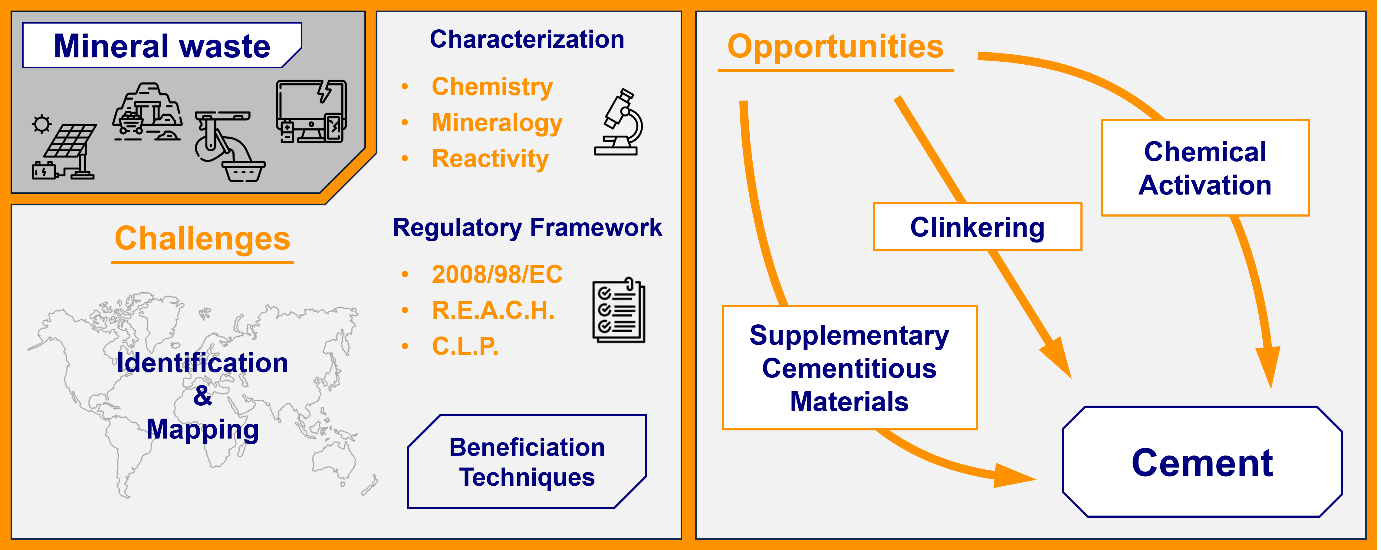
The cement and concrete industries are currently facing the urgent and arduous challenge of decarbonisation and material circularisation for improved resource efficiency. The pursuit of new raw materials and binders that will improve sustainability is urgent, especially as end-of-pipe carbon capture and storage (CCS) technologies have not yet been scaled up economically even after five decades of research and large investments. On the other hand, society is facing the colossal issue of managing mineral wastes which are produced in several Gts per year globally, posing a massive environmental and societal liability. Many of these mineral wastes have elemental and mineralogical profiles that make them good candidates for use as clinker raw feed or supplementary cementitious materials. Although the published research on the topic is extensive, it is not organised, lacking a systematic comprehensive approach, making valorisation challenging. RILEM TC UMW was developed to address this gap and create a framework for realising the potential of upcycling mineral wastes focusing on using powders as either clinker raw feed or other binder applications while excluding discussion on calcined clays and mineral carbonation.
Downloads
Published
How to Cite
Issue
Section
License
Copyright (c) 2025 Arne Peys, Luca Valentini, Aniruddha Baral, Arezou Babaahmadi, Priyadharshini Perumal, Marco Davolio, Liberato Ferrara, Antonios Kanellopoulos, Theodore Hanein

This work is licensed under a Creative Commons Attribution 4.0 International License.
Authors retain copyright of the articles published in RILEM Technical Letters and grant the journal the right of first publication with open access. The work is simultaneously licensed under Creative Commons Attribution 4.0 International License (CC BY 4.0) that allows others to share and adapt the work under the following terms: 1) a proper attribution is given in a form of bibliographic record with the DOI link directing to RILEM Technical Letters; 2) a link to the license is provided; 3) the changes (if any) are indicated.