
Thermodynamic modeling: Success in cement science – Untapped potential in corrosion research
DOI:
https://doi.org/10.21809/rilemtechlett.2025.214Keywords:
Corrosion, Steel, Concrete, pH, DurabilityAbstract
For more than a century, the corrosion of steel in concrete has prevailed as a complex and yet poorly understood phenomenon, with many durability design approaches relying on phenomenological or semi-empirical service life models. The increasing societal demand to maintain aging infrastructure, the development of new cementitious binders and the push towards an environmentally more benign and circular concrete economy exacerbate the need for a more comprehensive scientific understanding of the underlying physicochemical processes, particularly in the absence of long-term empirical data.
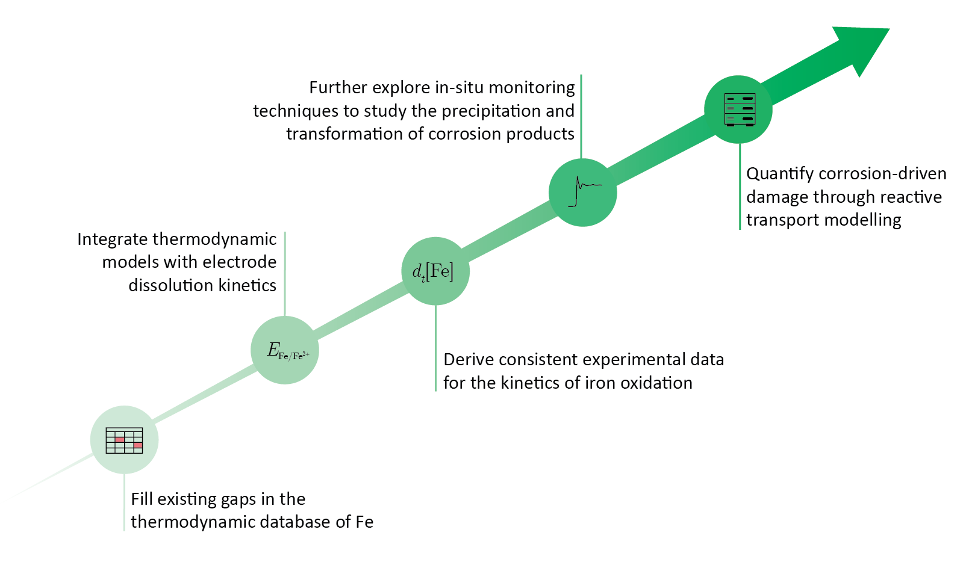
This manuscript retraces the history of thermodynamic modeling in cement and concrete research, examining early concepts, the barriers to adoption, and the pivotal role of modern Gibbs free energy minimisation solvers towards its broad level of acceptance within the scientific community. We further examine the current use of thermodynamic modeling techniques in corrosion science, emphasizing the limitations of classical potential-pH stability diagrams and addressing the widespread misconception that thermodynamics and kinetics are opposing concepts. Finally, we explore the opportunity to leverage the recent developments in the field of cement science and adopt thermodynamic modeling techniques in corrosion research, thereby addressing open questions related to the corrosion of steel in concrete.
Downloads
Published
How to Cite
Issue
Section
License
Copyright (c) 2025 Fabio Furcas, Barbara Lothenbach, Shishir Mundra, O. Burkan Isgor, Mette R. Geiker, Ueli M. Angst

This work is licensed under a Creative Commons Attribution 4.0 International License.
Authors retain copyright of the articles published in RILEM Technical Letters and grant the journal the right of first publication with open access. The work is simultaneously licensed under Creative Commons Attribution 4.0 International License (CC BY 4.0) that allows others to share and adapt the work under the following terms: 1) a proper attribution is given in a form of bibliographic record with the DOI link directing to RILEM Technical Letters; 2) a link to the license is provided; 3) the changes (if any) are indicated.