
The damage rating index (DRI): A practical guideline for autonomous operator training
DOI:
https://doi.org/10.21809/rilemtechlett.2025.216Keywords:
Alkali-silica reaction, Damage rating index, Operator training, Point-count microscopy, Damage characterizationAbstract
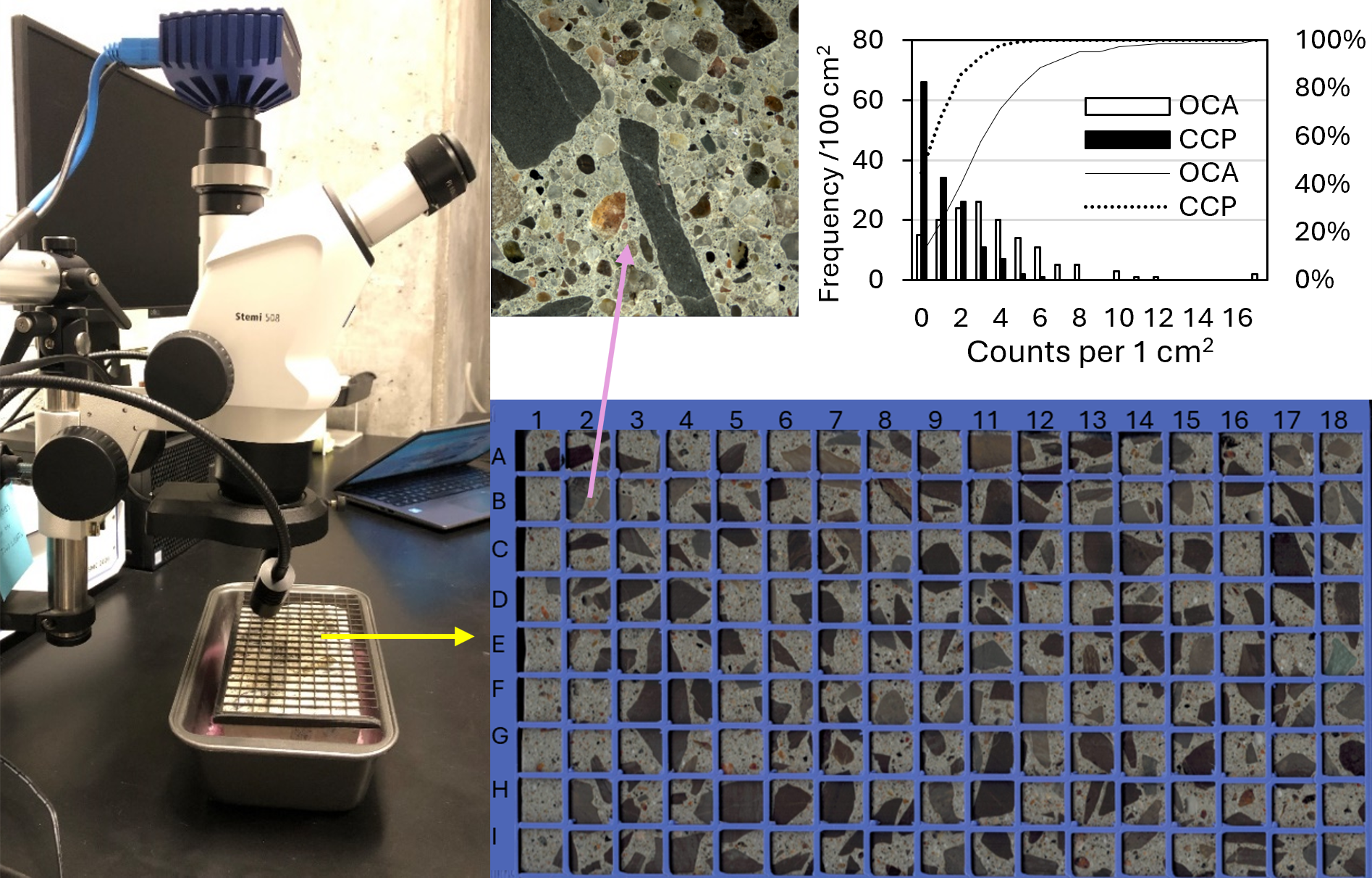
The damage rating index (DRI) is a microscopy tool that captures the extent of internal swelling reaction-induced deterioration (ISR). Although engineering practitioners more widely use mechanical tests, confirming the presence of ISR products through microscopy is required and standard practice. A more detailed evaluation can be achieved by combining mechanical and microscopy techniques, including the DRI, which has proven reliable in diagnosing the extent of ISR-induced deterioration. However, there is currently a lack of practical guidelines and standards in the literature explaining how to perform the DRI, raising concerns about the tool's use, particularly regarding operator variability and subjectivity. This work aims to create practical guidelines for conducting the DRI analysis methodology on concrete affected by alkali-silica reaction (ASR) originating from either reactive coarse or fine aggregates at various degrees of damage (i.e., 0.05%, 0.12%, 0.20%, and 0.30% expansion). Ranges of expected values were established to serve as autonomous training for new operators using the same reactive aggregates and mixtures.
Downloads
Published
How to Cite
Issue
Section
License
Copyright (c) 2025 Cassandra Trottier, Leandro F. M. Sanchez

This work is licensed under a Creative Commons Attribution 4.0 International License.
Authors retain copyright of the articles published in RILEM Technical Letters and grant the journal the right of first publication with open access. The work is simultaneously licensed under Creative Commons Attribution 4.0 International License (CC BY 4.0) that allows others to share and adapt the work under the following terms: 1) a proper attribution is given in a form of bibliographic record with the DOI link directing to RILEM Technical Letters; 2) a link to the license is provided; 3) the changes (if any) are indicated.