
Opening letter of RILEM TC 325-APS: Investigating the sustainability of alternative paving materials
DOI:
https://doi.org/10.21809/rilemtechlett.2026.223Keywords:
Pavement, Alternative materials, Alternative paving materials, Recyclability potential, Life cycle sustainability assessment, Life cycle analysis, Leaching, Toxicoology, Novel pollutantsAbstract
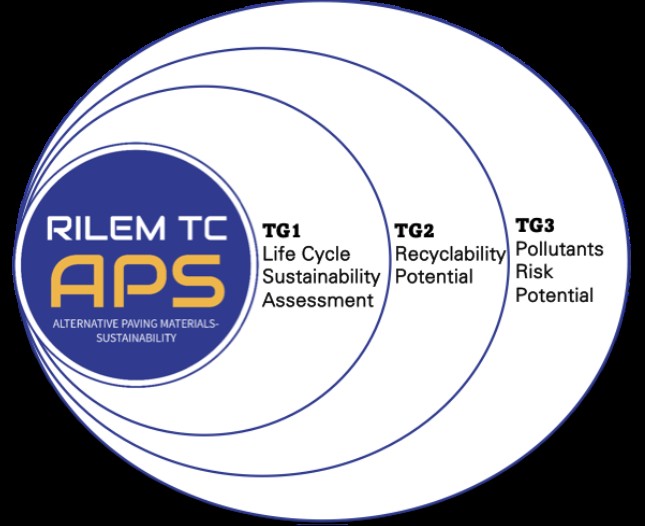
Material scientists and road pavement technologists recognize the potential for recycling and re-engineering end-of-life products to support the circular economy paradigm. The previous TC 279-WMR committee successfully investigated the utilization of waste and secondary materials in bituminous mixtures, generating significant interest and recommendations for their implementation in road construction. Building upon this foundation two RILEM committees have been established with the objective of developing a long-term strategy to minimize the use of conventional materials through the integration of alternative materials (AMs) engineered and re-used and/or recycled by incorporating them in bituminous mixtures, hence serving as Alternative Paving Materials (APMS) for surface layers. The present paper describes the vision of one of these committees, the technical committee APMSustainability (TC 325-APS), which will focus its efforts on assessing the sustainability of incorporating AMs within conventional bituminous paving materials with an approach linked to the following three technical groups (TGs): TG1 will look at developing Life Cycle Sustainability Assessment protocols for APMs to investigating their environmental, economic, and social impacts; TG2 will examine the Recyclability Potential of APMs; while TG3 will explore novel methods to identify and evaluate Pollutants Risk Potential associated with APMs. This comprehensive initiative aims to investigate the sustainability of adopting AMs in road construction, focusing the attention on the following selected APMs: recycled tire rubber, recycled plastics, and bio-based binders. The aims of the RILEM TC 325-APS aligns with Sustainable Development Goals 6, 9, 10, 11, 12, 13, 14, 15, 17 and with the principles of the circular economy and resilience. TC 325-APS is a multidisciplinary team with members from all over the globe, cooperating to provide practical recommendations and develop a long-term vision for the future of road construction materials.
Downloads
Published
How to Cite
Issue
Section
License
Copyright (c) 2026 Davide Lo Presti, Emmanuel Chailleux, Rita Kleizienė, Ana Jiménez del Barco Carrión, João Oliveira dos Santos, Pamela Haverkamp, Kamilla Vasconcelos Savasini, Katerina Varveri , David Hernando, Anand Sreeram, Filippo Giustozzi, Cesare Sangiorgi

This work is licensed under a Creative Commons Attribution 4.0 International License.
Authors retain copyright of the articles published in RILEM Technical Letters and grant the journal the right of first publication with open access. The work is simultaneously licensed under Creative Commons Attribution 4.0 International License (CC BY 4.0) that allows others to share and adapt the work under the following terms: 1) a proper attribution is given in a form of bibliographic record with the DOI link directing to RILEM Technical Letters; 2) a link to the license is provided; 3) the changes (if any) are indicated.