
Strain-level dependency in static and dynamic Young’s moduli characterisation of hydraulic lime mortars
DOI:
https://doi.org/10.21809/rilemtechlett.2025.224Keywords:
Young’s modulus, Hydraulic lime mortar, Strain-dependency, Digital image correlation (DIC), Material characterisationAbstract
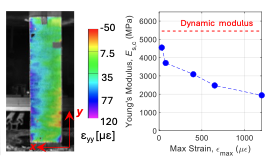
Young’s modulus is commonly estimated using dynamic tests or from load and deformation measurements under static loading. However, these methods may yield different results due to variations in strain levels where characterisation is conducted. Existing studies reported discrepancies between static and dynamic Young’s moduli of hydraulic lime mortar. This paper examines the role that strain amplitudes and testing configurations play during Young’s moduli characterisation of prismatic samples to understand the root causes for these differences. Dynamic characterisation is conducted using standard impulse excitation of vibration tests while static characterisation is done with three-point bending and uniaxial compression tests. A tailored loading regime is used to examine the evolution of Young’s modulus at different strain levels. Repeated IEV measurements reveal progressive decay with increasing strain amplitudes. A similar trend is observed for static moduli, although decay magnitudes are notably higher and depend on the adopted test configuration. Reductions in Young’s moduli are associated with microscale damage processes and were observed at strain levels as low as 100 με. They become notably pronounced at compressive loads corresponding to ~30% of material compressive strength, which is typically used for static elasticity characterisation. The results highlight the small-strain nonlinearity of hydraulic lime mortar and indicate the need for improved characterisation procedures to describe the constitutive behaviour of this material.
Downloads
Published
How to Cite
Issue
Section
License
Copyright (c) 2025 Marialuigia Sangirardi, Miles R.W. Judd, Anil Ozdemir, Sinan Acikgoz

This work is licensed under a Creative Commons Attribution 4.0 International License.
Authors retain copyright of the articles published in RILEM Technical Letters and grant the journal the right of first publication with open access. The work is simultaneously licensed under Creative Commons Attribution 4.0 International License (CC BY 4.0) that allows others to share and adapt the work under the following terms: 1) a proper attribution is given in a form of bibliographic record with the DOI link directing to RILEM Technical Letters; 2) a link to the license is provided; 3) the changes (if any) are indicated.