
Nano silica admixtures: Salt ingress and reaction in mortar
DOI:
https://doi.org/10.21809/rilemtechlett.2026.226Keywords:
Colloidal silica, Nano silica, Admixtures, Deicing salts, Hydration, Pozzolanic reactionAbstract
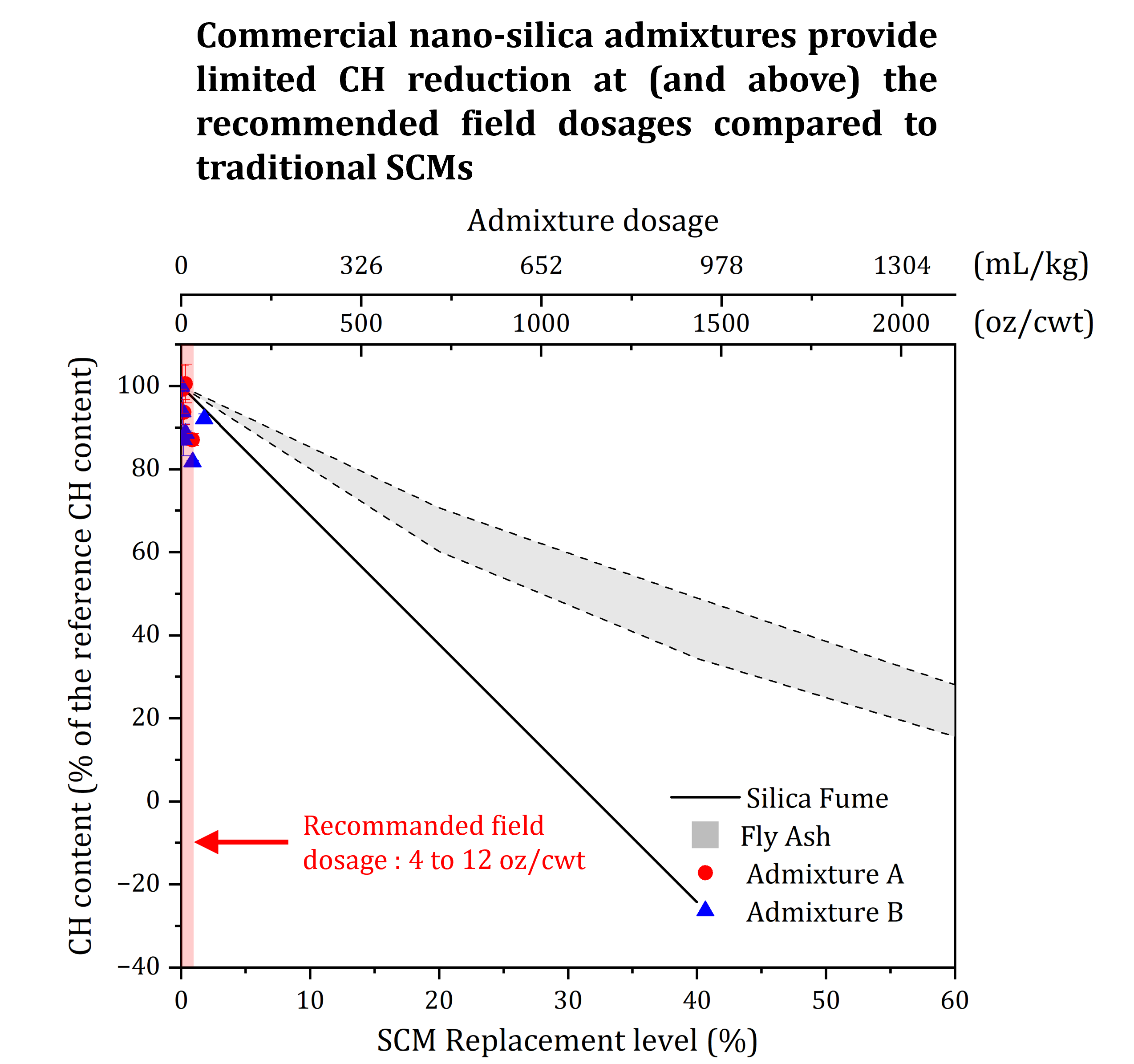
This paper examines the influence of commercially available nano silica (NS) admixtures on salt ingress and reaction in mortar. A series of mortar mixtures at dosages ranging from 2.6 to 41.8 mL/kg were tested using isothermal calorimetry (IC), thermogravimetric analysis (TGA), low temperature differential scanning calorimetry (LTDSC), and chloride profiling. Thermodynamic modeling was used to support the experiments. IC showed that the heat of hydration was slightly higher (2-3%) than the reference mixture when the NS admixtures were used. TGA indicated up to 18% reduction in calcium hydroxide at low admixture concentrations (2.6 to 7.8 mL/kg), which is greater than the reduction that would be expected due to pozzolanic reactions alone. At higher admixture dosages (above the recommended dosages), the calcium hydroxide contents were similar to or higher than those of the reference mixture. LTDSC results showed up to a 30% reduction in calcium oxychloride (CaOXY) formation potential; however, this reduction may not be sufficient to avoid the potential damage associated with expansive CaOXY formation at concrete joints in pavements and flatwork. The NS admixtures did not affect chloride ingress profiles significantly. Thermodynamic calculations indicate that although the admixtures provide reactive silica that acts pozzolanically, the amount is relatively small compared to the admixture dosages used.
Downloads
Published
How to Cite
Issue
Section
License
Copyright (c) 2026 Julien Hubert, Fengyin Du, Cibele De Araujo, O Burkan Isgor , W Jason Weiss

This work is licensed under a Creative Commons Attribution 4.0 International License.
Authors retain copyright of the articles published in RILEM Technical Letters and grant the journal the right of first publication with open access. The work is simultaneously licensed under Creative Commons Attribution 4.0 International License (CC BY 4.0) that allows others to share and adapt the work under the following terms: 1) a proper attribution is given in a form of bibliographic record with the DOI link directing to RILEM Technical Letters; 2) a link to the license is provided; 3) the changes (if any) are indicated.