Isotope chemistry to trace carbon mineralization in construction materials
DOI:
https://doi.org/10.21809/rilemtechlett.2026.232Keywords:
Isotopes, Carbon Mineralization, Recarbonation, Construction Materials, CO2 tracingAbstract
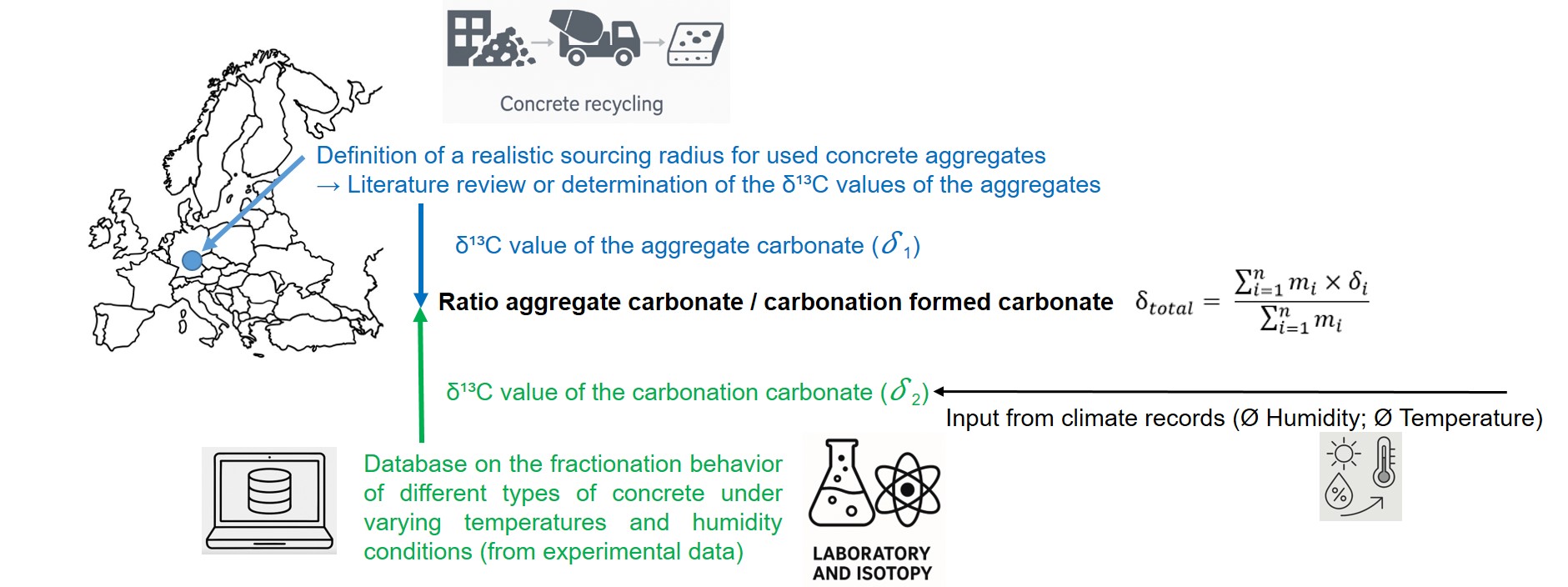
This contribution presents an overview of the current literature and application potential of carbon isotope analysis in cementitious systems. Stable carbon isotope ratios (¹³C/¹²C) offer powerful insights for tracking carbonation processes, especially in the context of carbonation hardening and the characterization of recycled concrete fines. Isotope methods can help determine the extent of carbonation and to distinguish between naturally formed carbonates and those resulting from enhanced carbonation by fossil CO2. This approach offers a valuable tool in circular construction strategies.
Alongside published studies, we highlight recent experimental work that further demonstrates potential applications of this method. However, to fully exploit carbon isotopes as a diagnostic tool, several questions remain open. In particular, isotope fractionation during carbonation is not yet fully understood. Key factors of influence include temperature, pH, relative humidity, porosity of the carbonated material and the isotope composition of the CO₂ source. Moreover, differences between aqueous and gaseous carbonation must be evaluated, as they may result in different isotope fractionation.
Understanding these fractionation mechanisms is essential to establish robust interpretation frameworks for isotope-based approaches in cement and concrete research and applications.
Downloads
Published
How to Cite
Issue
Section
License
Copyright (c) 2026 Daniel Jansen, Thomas Matschei, Robert van Geldern, Johannes Barth, Ruben Snellings

This work is licensed under a Creative Commons Attribution 4.0 International License.
Authors retain copyright of the articles published in RILEM Technical Letters and grant the journal the right of first publication with open access. The work is simultaneously licensed under Creative Commons Attribution 4.0 International License (CC BY 4.0) that allows others to share and adapt the work under the following terms: 1) a proper attribution is given in a form of bibliographic record with the DOI link directing to RILEM Technical Letters; 2) a link to the license is provided; 3) the changes (if any) are indicated.