
Report of RILEM TC 301-ASR: Framework for risk assessment of mixture designs incorporating alkali-silica reactive aggregates
DOI:
https://doi.org/10.21809/rilemtechlett.2026.233Keywords:
Alkali aggregate reaction, Concrete durability, Probabilistic risk assessmentAbstract
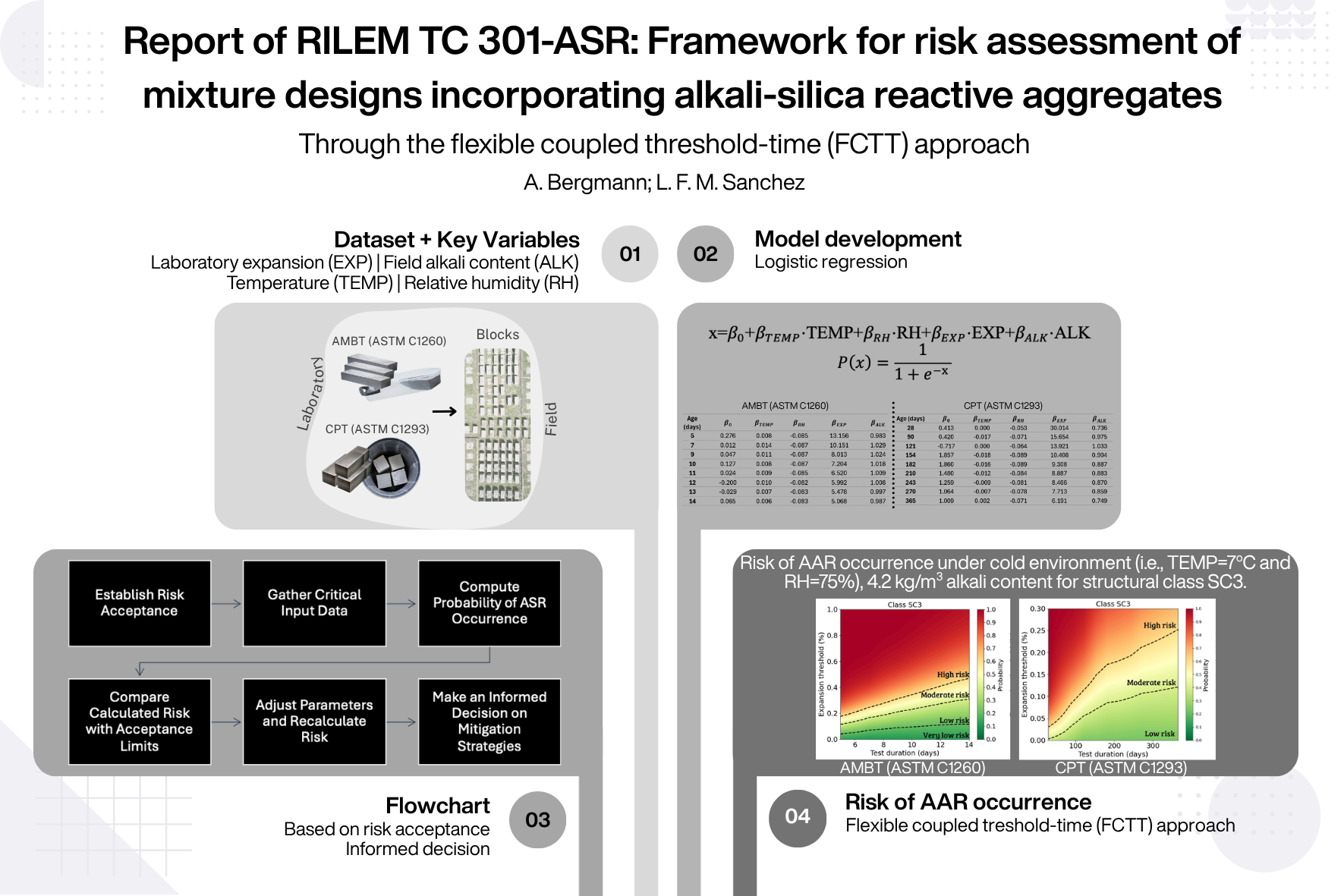
Alkali-aggregate reaction (AAR), a harmful durability mechanism affects concrete structures worldwide. Over the years, it has become clear that prevention is the best strategy against AAR. In this sense, guidelines have been developed relying on accelerated laboratory tests, including the Accelerated Mortar Bar Test (AMBT), as per ASTM C1260, and Concrete Prism Test (CPT), as per ASTM C1293, to define mitigation strategies and plans. However, current thresholds frequently fail to predict the actual field behavior of concrete over extended periods. In this sense, this study introduces a probabilistic framework integrating laboratory and field data with logistic regression to predict ASR risk, a flexible coupled threshold-time (FCTT) approach. The framework incorporates environmental conditions, alkali content, and structural classification to define the risk of AAR field occurrence. It allows for dynamic risk assessments and informed decisions on mitigation strategies based on a structure's specific information, improving alignment between laboratory outcomes and real-world durability.
Downloads
Published
How to Cite
Issue
Section
License
Copyright (c) 2026 Ana Bergmann, Leandro F. M. Sanchez

This work is licensed under a Creative Commons Attribution 4.0 International License.
Authors retain copyright of the articles published in RILEM Technical Letters and grant the journal the right of first publication with open access. The work is simultaneously licensed under Creative Commons Attribution 4.0 International License (CC BY 4.0) that allows others to share and adapt the work under the following terms: 1) a proper attribution is given in a form of bibliographic record with the DOI link directing to RILEM Technical Letters; 2) a link to the license is provided; 3) the changes (if any) are indicated.