Experimentally determined material properties of stabilised compressed earth block masonry
DOI:
https://doi.org/10.21809/rilemtechlett.2026.241Keywords:
Material Properties, Test Methods, Shear Bond Tests, Wall Tests with Inclined Bed Joints, Stabilised compressed earth block masonryAbstract
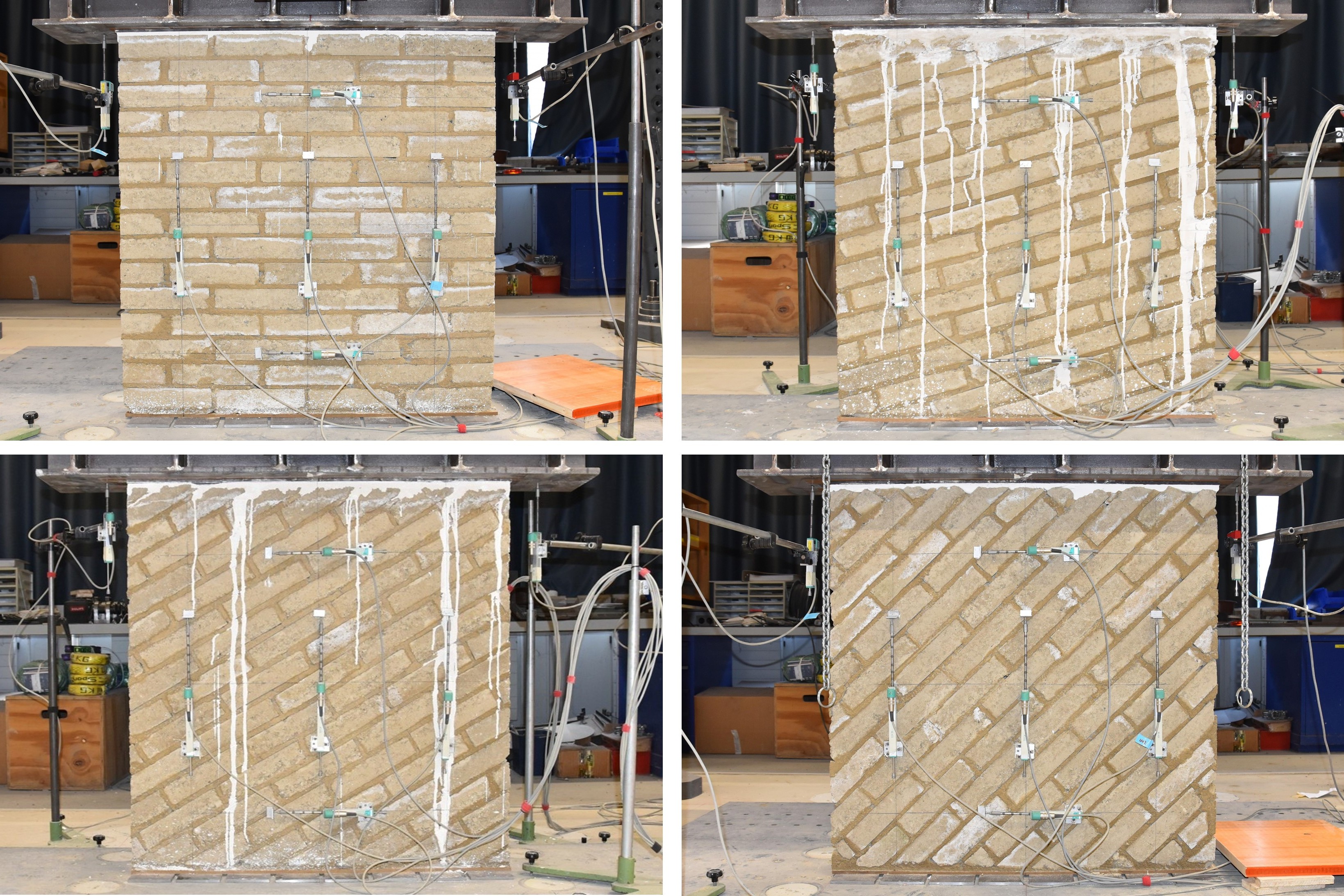
This study presents an experimental investigation of the mechanical behaviour of an earthen masonry system composed of cement-free stabilised compressed earth blocks (CEBs) and earthen mortar. The test program included compressive strength tests on individual masonry components, shear bond tests under varying pre-compression levels, and compressive strength tests on wall elements with horizontal and inclined bed joints.
The results show that strength of a CEB does not allow for a prediction of the masonry strength. The strength test of a single CEB leads to an overestimation and interactions between units and mortar influence structural response. The initial shear strength value deducted from shear bond tests shows considerable variation depending on the precompression levels considered for evaluation, limiting the suitability for deriving design parameters. In contrast, wall tests with inclined bed joints provide a more consistent representation of the combined normal–shear stress state and allowed reliable assessment of strength and failure mechanisms.
A pronounced reduction in compressive strength was observed with increasing bed joint inclination, followed by a plateau up to the internal friction angle and a subsequent drop to very low strength levels corresponding to sliding failure. This behaviour is comparable to that observed in conventional masonry with fired bricks. The findings indicate that established design approaches, such as SIA 266, may be applicable to earthen masonry, provided material-specific aspects are considered. Further investigations on additional diverse earthen raw materials are required to generalise the results.
Downloads
Published
How to Cite
Issue
Section
License
Copyright (c) 2026 Iris Durrer, Uwe Teutsch, Letizia Caderas

This work is licensed under a Creative Commons Attribution 4.0 International License.
Authors retain copyright of the articles published in RILEM Technical Letters and grant the journal the right of first publication with open access. The work is simultaneously licensed under Creative Commons Attribution 4.0 International License (CC BY 4.0) that allows others to share and adapt the work under the following terms: 1) a proper attribution is given in a form of bibliographic record with the DOI link directing to RILEM Technical Letters; 2) a link to the license is provided; 3) the changes (if any) are indicated.