Making low-clinker cements work: Constraints, chemical activation, and region-specific pathways
DOI:
https://doi.org/10.21809/rilemtechlett.2026.247Keywords:
Cement decarbonation, Low-clinker cement, Chemical activation, Supplementary cementitious materials, Performance-based standardsAbstract
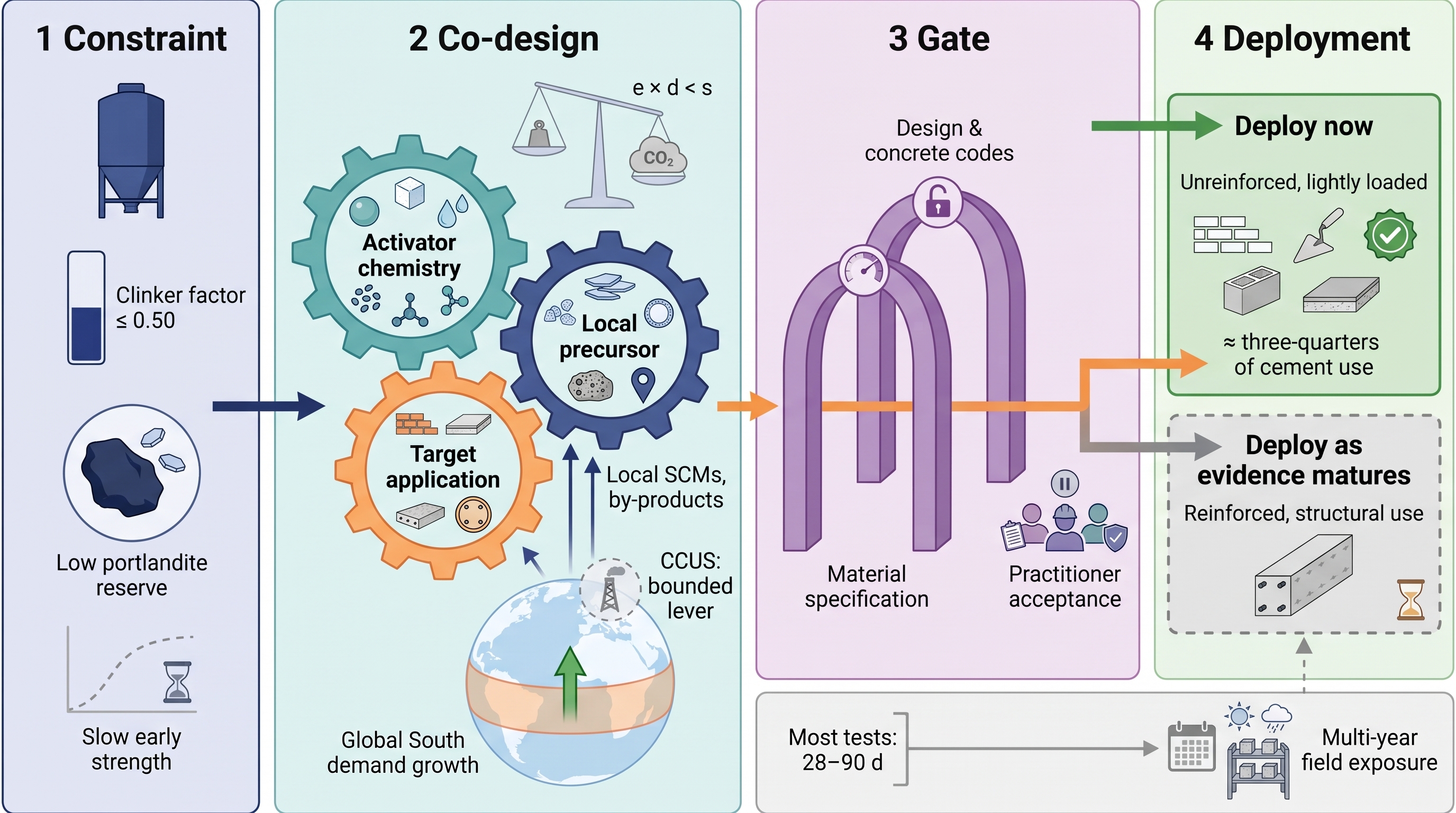
Decarbonising cement requires lowering the clinker factor, yet binders in which clinker falls below about half of the binder mass often suffer kinetic and thermodynamic constraints that delay early strength and leave durability performance uncertain. Chemical activation, through calcium-based additives, low-dosage salts, hybrid alkaline systems, nucleation seeding, or alkanolamines, is the most direct means of recovering early performance, although each route trades early against later-age behaviour and carries an embodied carbon cost of its own. Because cement production and resource availability vary strongly by region, locally available precursors such as low-grade calcined clays, industrial by-products, and natural pozzolans must anchor regional pathways, even as centralised, traded supply chains coexist with regional ones. This letter argues that low-clinker binders underperform less because a single technical solution is missing than because activation chemistry, the locally available precursor, and the target application are treated in isolation, and that this technical difficulty is compounded by the scarcity of performance-based specifications in many regions and by the hesitancy of practitioners even where such specifications already exist. Since a large share of cement serves unreinforced and lightly loaded applications, low-clinker binders can be deployed there with confidence today, while durability data and performance-based specifications mature for reinforced and structural application.
Downloads
Published
How to Cite
Issue
Section
License
Copyright (c) 2026 Muhammad Riaz Ahmad

This work is licensed under a Creative Commons Attribution 4.0 International License.
Authors retain copyright of the articles published in RILEM Technical Letters and grant the journal the right of first publication with open access. The work is simultaneously licensed under Creative Commons Attribution 4.0 International License (CC BY 4.0) that allows others to share and adapt the work under the following terms: 1) a proper attribution is given in a form of bibliographic record with the DOI link directing to RILEM Technical Letters; 2) a link to the license is provided; 3) the changes (if any) are indicated.