
Preservation of the protective function of calcium aluminate-based coating against biodeterioration in presence of cracks
DOI:
https://doi.org/10.21809/rilemtechlett.2025.217Keywords:
Durability test, Wastewater treatment plants, Calcium aluminate cement, Biodeterioration, CrackingAbstract
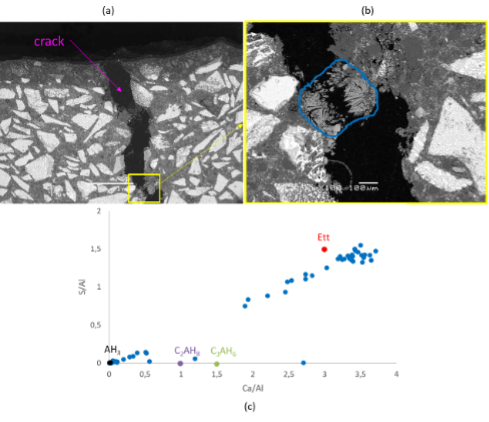
The durability of wastewater treatment plants has been a major concern for decades due to their significant economic and health importance. Structures built with concrete are subject to severe deterioration linked to aggressive chemical and biological exposure conditions. Portland cement concrete is particularly vulnerable to such attacks leading to major damages in the structures. One of the strategies to protect this concrete from the effects of biodeterioration is applying a thin coating based on calcium aluminate cement. These materials were proved to have a superior resistance to biodeterioration compared to ordinary Portland cement. However, the cracks initiated in the protected structure that might reach the coating raise questions on its ability to fulfill its protective role. This paper aims to study the effect of the crack on the durability of the coating using a biological laboratory test, the BAC test, which simulates the real conditions encountered in a sewer system. The calcium leached from the specimens exposed to the biogenic sulfuric acid attack was monitored in two campaigns of the BAC test. Each campaign was performed on reference OPC-based uncoated specimens and coated specimens with the CAC-based coating: uncracked and cracked with two ranges of crack width between 150 and 200 µm and between 400 and 500 µm. The leaching results demonstrate that the protective function was not altered by the effect of the cracks when comparing the reference uncoated specimen to the coated ones. The SEM-EDS observations show the existence of a newly-formed phase in the few hundreds of micrometers from the exposed surface of the coated specimens. This phase was composed mainly of calcium, sulfur and aluminum and was probably a mix of AH3 and ettringite. The formation of this phase near and inside the crack opening could possibly act as a physical barrier that prevents further deterioration.
Downloads
Published
How to Cite
Issue
Section
License
Copyright (c) 2025 Reem Hoballah, Matthieu Peyre Lavigne, Cédric Patapy, Laurie Lacarriere, Ahmed Toumi, Amr Aboulela, Alexandra Bertron

This work is licensed under a Creative Commons Attribution 4.0 International License.
Authors retain copyright of the articles published in RILEM Technical Letters and grant the journal the right of first publication with open access. The work is simultaneously licensed under Creative Commons Attribution 4.0 International License (CC BY 4.0) that allows others to share and adapt the work under the following terms: 1) a proper attribution is given in a form of bibliographic record with the DOI link directing to RILEM Technical Letters; 2) a link to the license is provided; 3) the changes (if any) are indicated.