
Article of RILEM TC 313-MMS: Importance of moisture for corrosion-related concrete durability
DOI:
https://doi.org/10.21809/rilemtechlett.2026.246Keywords:
Moisture, Concrete durability, Steel corrosion, Carbonation, Chloride ingressAbstract
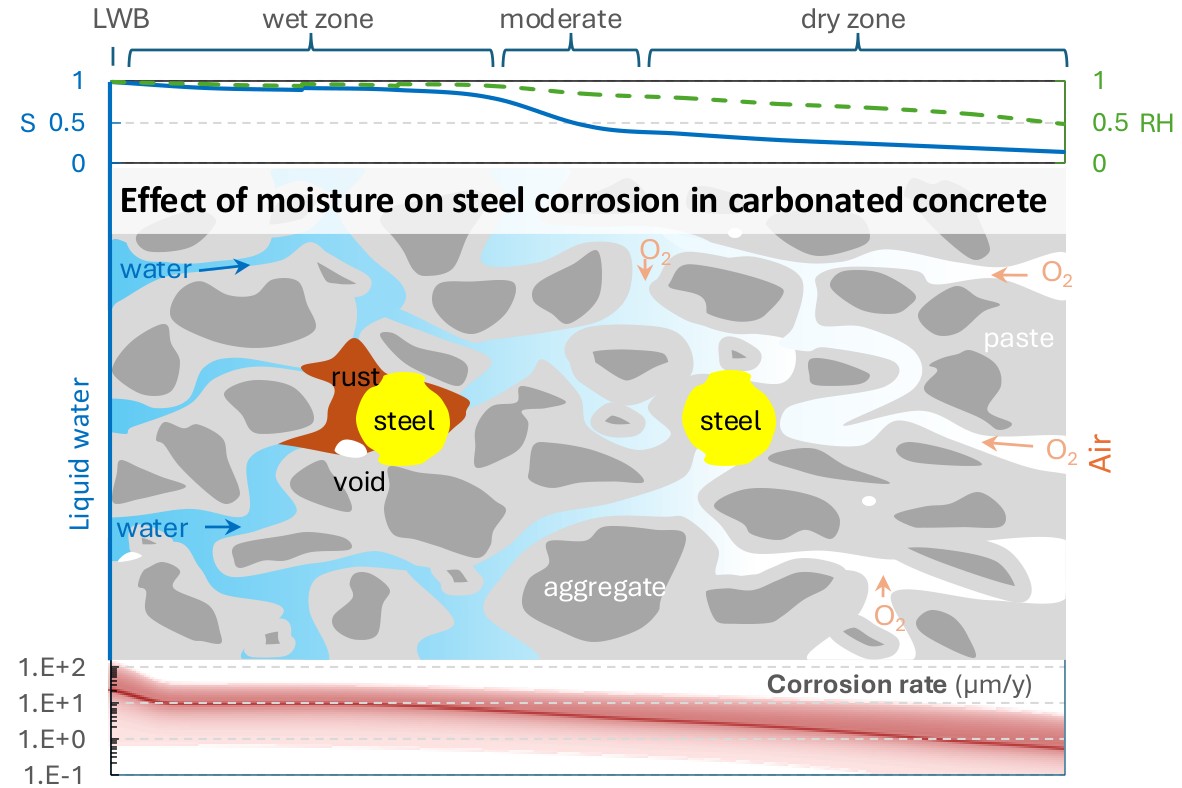
The durability of steel-reinforced concrete is significantly influenced by moisture, which governs the transport of aggressive agents, and the initiation and propagation of reinforcing steel corrosion. Both carbonation- and chloride-induced corrosion are largely related to water penetration, with corrosion rates increasing significantly upon the arrival of waterfront to the steel surface. As the construction sector transitions toward low-carbon binders and concrete with reduced carbonation resistance, understanding internal moisture state and its transport is essential to ensuring concrete durability. This letter critically reviews the multifunctional role of moisture in corrosion-related durability, encompassing carbonation, chloride ingress, and steel corrosion. Key moisturerelated mechanisms at the steel-concrete interface (SCI), differences between carbonation- and chloride-driven corrosion, and limitations in current moisture characterization methods - both experimental and modeling - are discussed. The letter concludes by outlining research needs and opportunities.
Downloads
Published
How to Cite
Issue
Section
License
Copyright (c) 2026 Zhidong Zhang, Chunsheng Zhou, Natalia Alderete, Ueli Angst, Tamara Janey Chidiac, Bingbing Guo, Liming Huang, Luka Malenica, Alexander Michel, Lars-Olof Nilsson, Christoph Strangfeld, Qingxiang Xiong, Qiang You, Zengfeng Zhao

This work is licensed under a Creative Commons Attribution 4.0 International License.
Authors retain copyright of the articles published in RILEM Technical Letters and grant the journal the right of first publication with open access. The work is simultaneously licensed under Creative Commons Attribution 4.0 International License (CC BY 4.0) that allows others to share and adapt the work under the following terms: 1) a proper attribution is given in a form of bibliographic record with the DOI link directing to RILEM Technical Letters; 2) a link to the license is provided; 3) the changes (if any) are indicated.